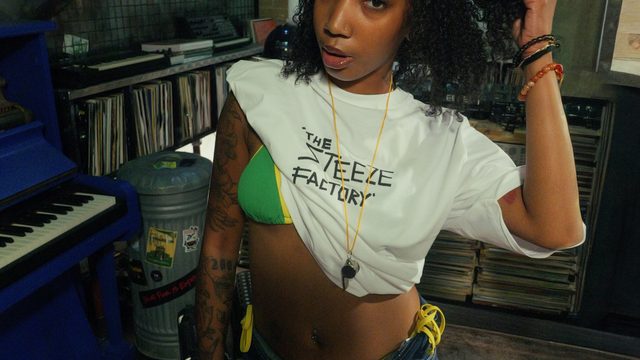
Meet Diya Sohi – singer, actor, performer, and rising star redefining what it means to be a triple threat. With bold vocals, genre-blending soundscapes, and a self-directed career, she’s forging a new path in UK R&B.

You say the phrase “triple threat” and the likely response is a laboured eye roll. Considered a bit of a myth, the all-singing, all-acting, all-dancing prophecies are few and far between, with the rarefied starlets of the industry sitting pretty on the pedestal of legacy success from years gone by. It’s hard not to grow cynical in this quagmire of showbiz – being good at everything isn’t easy, and for many not possible, but for the determined few, the road to triple threat status is self-made, but well-paved. Diya Sohi is one of those coveted few, an artist, actor, and performer with a star-studded catalogue of work spanning stage, camera, and theatre, with a rich future ahead of her, and a family of supporters by her side.
“My music is for me, but also for girls who look like me, and who have never felt seen,” shares Diya. “I have been that girl… who doesn’t feel seen by the genres that I make music for”, a facet of the R&B world that she unpacks with real grace. “Now I notice that when people hear my voice, they know I belong there”, she shares, a lasting testament to her timeless sound and versatile voice. A true triple threat in the making.
For someone who doesn’t know your music, how would you describe your sound?
I would describe my music as pop-heavy jazz, with R&B influences, very theatrical and dramatic. I feel like it gives that smoky jazz bar vibe, that’s very much the world I like to create. It’s the intrigue, but also being as raw and honest as I can with my lyrics. There’s a balance between having that grandiose drama, but also being really easy to connect with.

What kind of things do you write about?
Honestly, a bit of everything. When I go into a session, it’s whatever I feel is calling me from within. It’s that message that everyone is on their own journey, and it won’t really be worth it to be someone that isn’t yourself. My music is all about discovering myself and the new experiences I’m having, it will always be that capsule for me to look back on. That’s how I was feeling when I was 19, all that kind of stuff.
Do you have any core musical influences or artists who inspire you?
One album that shaped my life is I Am Sasha Fierce by Beyoncé, all the dramatic ballads in that album, but also the songs that make you want to move and dance… I feel that’s so integral to my journey as a musician and it will always be with me. I love so many genres, but I will always come back to that. I started to love jazz because I played the tuba and because I was discovering artists like Amy Winehouse, and she has that big brass sound which I adore, and then the elements of hip hop that are in there. It came to a point where she made her own genre, it was so uniquely her that anyone could listen and hear that it’s an Amy Winehouse type song. That’s something I want to eventually come to, so that people can listen to something and think that that’s something Diya would sing.
Those are my main genres, and those are my two main inspirations, but there are so many people – Mariah Carey, Whitney Housten, all the massive pop divas, I’ve loved them all my life. I’ve always just loved the big vocal powerhouse divas. That’s what I want to be.

Tell me a bit about your acting career…
I got a lead in the Tracy Beaker franchise when I was 16, and I had these perfect four months where I went to Bristol, was put up in an apartment, and went to go and film. It was honestly one of the most surreal experiences, and taught me so much about being professional and how to hold yourself and communicate with people. Then I’d come out of that, and I auditioned for a pantomime, and I’d never seen a pantomime in my life, but I got the role of the princess in Aladdin. I wrapped filming, and then the next day I started Year 13, I went to school for like two-ish months, then left school again to do the pantomime.

How has your time in front of the camera and the crowd influenced your musical performances?
The pantomime and TV acting are like two entirely different worlds. TV acting is all about the inner, and communicating what your character is really thinking and feeling through the tiniest movements, especially if you’re in a close up. That taught me so much about how someone can say one thing but mean something entirely different and is something that’s been integral to my music, about finding those nuances when people are communicating, sometimes they don’t have the words for how they really feel. That’s what I feel my music is, and that is because of my acting training on TV. But then the pantomime kind of tore me completely away from that, like bare everything on stage, now!
I feel like all my shows now are such a two way conversation. It’s never about people coming to see someone sing, it’s about them feeling an experience and really feeling my songs and feeling seen. I will always, no matter what, no matter how far I get in my career, hold the microphone to the crowd and tell my audience to sing, because for me, that’s pantomime, that’s the choirs I’ve done, that’s me going to shows and seeing Beyoncé, that’s showmanship, and that’s what I feel my shows are because of my acting training.

How did you find UD Music?
So that started with Flames Collective. I just felt so seen and understood by them, the entire team. Everyone there has only ever supported me – they have genuinely helped me with everything and it’s one of the communities I’ll always be so incredibly grateful for. I’d seen the Incubator Programme and I’d spent my time really trying to figure out what music I want to make because coming from musical theatre, my voice is versatile. Then I came to UD.

You’ve performed with Flames for RAYE and Sasha Keable on some pretty big stages. How have you found those experiences?
Singing with RAYE has been one of the greatest experiences. I’m such a firm believer that everything happens for a reason, and rejection is redirection, and so being on that main stage, performing to like 100,000 people, seeing that crowd, feeling that feeling, singing music that I felt so passionate about and so understood, especially having seen the show at the Royal Albert Hall myself, that transitional period was honestly incredible and something I’ll never forget. I feel like for me, I know that music is my calling and music is what I feel understood by.

Photo: Luke Dyson @lukedyson www.lukedyson.com
Were there any “secrets of the industry” that you discovered having studied with UD or things you weren’t previously aware of?
I feel like the best lessons for me in terms of my career are always the things people have said, but when they’re really shown to you in action. One thing that I’ve learned is that if you are so sure of who you are and what you deserve and what you want to be and where you want to get, there’s no one that can stop you, and if there are people that are trying to stop you, someone else won’t.
“My music is for me, but also for girls who look like me, and who have never felt seen. I have been that girl, and truthfully I am that girl who doesn’t feel seen by the genres that I make music for.”
Diya Sohi
Did not feeling represented in those genres put you off making music?
I’ve never known anything other than R&B and pop growing up. I did classical training, so I would sing songs in French and Latin and all that sort of stuff, and I’d come home and I’d be listening to Neo and Usher and Beyoncé (laughs).
When I was young, I didn’t notice a resistance because I didn’t really sing in R&B spaces when I was younger. Now I notice that when people hear my voice, they know I belong there. Then again, it’s something that my mum has always told me, that in a lot of spaces, I’ll have to work 10 times harder to get just as far. I found that getting onto shows, a lot of people think I have management; I do not, shout out to any managers if you want to sign me, I’m here (laughs). I find everything myself and I know that I have to work hard to get to where I want to be and there’s so much further I can go, and I know I will go. But right now I have myself and all the shows I do, I find myself. I’m grafting, and I’m getting out there as much as I can, because I know that once people hear my voice, I’ll go further.

Have you collaborated with anyone or have plans to?
Jedz is an incredible artist, and I’ve always loved a song with a male and female duo where there’s a female voice on the adlibs and chorus, like Amy Winehouse and Nas on ‘Cherry Wine’, all those sorts of things. So Jedz doesn’t know this yet, but I really want to work with him. (Laughs)

If you were to perform in your ideal venue where would it be? What would your dream stage set up be?
My ideal stage is a space where as many people as possible can come and watch a show. People of all races, gender expressions, ages… everything. I love when there are fireworks, I love when there’s confetti, but actually the confetti is a fake dollar bill – a Diya dollar with my face on it (laughs). I like the world building, feeling like you’re really immersed in that world.

What are the next steps for you? What can we look forward to?
I will be releasing my debut single in early 2026 – I don’t know when… but, soon, which is everyone’s favourite word (laughs). When I release them, everyone’s going to be introduced to my world. I’m excited. It’s a pop song, slightly leaning on the R&B side, but mainly pop which is exciting and a new sound I am really enjoying exploring at the moment.
Also, if anyone’s free, I have a live show at the Troubador on 27/11/2025 as part of Solstice Sounds Live!
Follow Diya’s journey on Instagram, TikTok & YouTube.
Words: Elsa Monteith, a Brighton based writer and broadcaster working in and around the arts and on the radio waves. Subscribe to Elsa’s Discontented newsletter here.