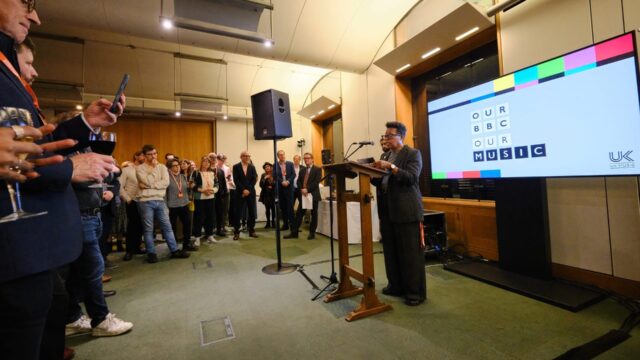
On the 23rd January, UD hosted an in-person book launch and conversation with Dr Joy White, author of Like Lockdown Never Happened, discussing how Black music and Black creative expression soundtracked and sustained us through COVID-19, and how this work continues to shape our relations to culture and to each other. Elsa Monteith reports…

Whilst some lost their sense of smell during Covid-19, our proverbial taste in good music remained steadfast, with Dr Joy White’s astute observations and research reminding us that Black creative expression has always been, and will continue to be, the soundtrack to all our lives.

The Covid-19 pandemic was the closest many of us will get to a truly universal experience. For many, time stood still as we were confined to the parameters of our households, a worldwide phenomenon that cost countless lives, and left irreparable social, environmental, and economic damage in its wake. As we approach the five year marker of the first lockdown this March, Dr Joy White’s book stands as a stark reminder of the pandemic’s impact on our collective psyche through the lyrical lens of music, and in particular, Black music.

“We were all navigating ‘pandemic time’”, shares Joy, a term that comes up repeatedly during the conversation, a stretch of days, turning into months and years passing that deviated from the conventional chronology of our contemporary times. Joy refers to this deviation as “kairotic”, a term used to describe a moment when something happens that couldn’t have happened at any other time or place. Music during the Covid-19 years can be described as exactly that; a product of its time, enduring conditions new, unknown, and perpetually stuck in the continual reverb of “pandemic time”.
As we dive deeper into Joy’s book, we are met with a dissection of the disorienting experience of the lockdowns, and an analysis of aspects of the “contemporary conjuncture” through a combined approach of “sequential, quantitative time”, as well as an appreciation for the fluid fluctuation of “qualitative time”. There was a clear shift in how we participated in music after March 2020, both in using it as a tool to satiate boredom, but also as a means of staying connected and managing enforced isolation. As we were isolated and then socially distanced, “time changed shape” Joy shares, a nod to the bedroom DJ livestreams, digital gigs, and online house parties that emerged during that time, and the impact that’s had on how we engage with music ever since.

So how do we meditate on time when it is sequential, fluctuating, and happening during a pandemic? Joy asks this question in her book and answers it with the enduring philosophy of Michael Marder, a writer and thinker that established the useful concept of “passenger time”. By outlining this framework in her book, Joy explains Michael’s concept as a sense of time that allows us to consider how we can mark the span between places, as well as take into account our “departure and our destination”. Placing this in the context of archiving and observing music in the pandemic, we look at the ticking of the clock and passing of time as an unchanged and ongoing constant, but acknowledge that how we experience that time is different for all of us. The beginning of March 2020 was the starting line for many, but the pit stops (and Spotify Wrapped) along the way were unique to each.
As the demand for the NHS began to rise at a rapid rate previously unseen, the UK public felt a collective despair for how to acknowledge or appreciate its effort, as the government’s fraught and erratic response was widely perceived as too little too late. In a desperate effort to do something, there was a call for residents to loiter on their doorsteps, stairwells, or reach outside their windows at 8pm on Thursday evenings to clap for the NHS. Some would say this was a desperate or anguished gesture enacted with what little power the public had, to acknowledge the immense struggle that keyworkers were enduring, whilst many of us were sitting squarely on the sofa, and paid a sum to be there.

Joy documented this, audio recording the “mass community applause” that resounded across the country for 10 consecutive weeks, noting the difference in sound as it progressed. In her book, she delves into what clapping can mean in the context of sound and community, “it can provide the beat for a song or a dance; outside of music it can show approval or – as a slow hand clap – disapproval.” The longer the applause, Joy notes, might signify the “depth of approval”, and might include the introduction of other sounds which Joy noticed from her doorstep, hearing “cheers, the beat of saucepan lids and, in my neighbourhood, the guy from the corner shop blowing his trumpet for the NHS.”
As we move into the centrality of Black music in pandemic life, Joy shares how the book follows concepts of “Black joy and sonic Black geographies” in its analysis, exploring what thinker Christopher Smalls calls “musicking”. This term is expansive and generous, taking into account the dancing, playing, listening to, as well as making that surrounds music, something that Joy has extended for our digital age to include responding to and commenting on music.
Described by Joy as the “crucible of the pandemic”, Black creative expression and the “Black Atlantic flow of music” reverberates throughout the conversation. The online spaces that we occupied (and continue to populate) during the pandemic facilitated this expression, with online radio station No Signal connecting a wide listenership by way of Black Twitter. Entertaining an expansive international audience, digital radio allowed listeners to participate in what Joy describes as an “imagined mediated liveness”, sharing a feeling of “co-presence”. This engagement felt collective, communal, and for many comforting, another shared experience that cultivated joy in a different way, chiefly through music and conversation.
Returning to Joy’s extended idea of “musicking”, we visit an ethnographic study of the music-sharing practices of Spanish migrants in London conducted by ethnomusicologist Raquel Campos Valverde. The study extends musicking even further to include the concept of “imagined listening”, a form of “sociality based on how we think others listen to music”, something we often dwell on as songwriters and musicians ourselves. Used as a tool to explain the social relationships that arise from people’s interaction with online music and digital sonic experiences, Raquel’s work delves into sharing music as a way of “articulating their cultural identity”, as well as making connections with each other. We see this in our own contemporary digital sharing practices, perhaps in the forwarding of viral clips or “sounds” on Instagram or TikTok, and the discovery of new music via online, algorithmic means.

Despite originally focusing on classical music, Christopher’s concept of “musicking” brings together the converse universality of music as a means of communication, with the connection and relationship between the music and audience being a particularly intimate one. Social media augments this, with live and direct access to fan-artist interaction (at their discretion) being no longer a thing of the past. “Boundaries are blurred”, as Joy says, “not only between the artist and the audience, but also between time and space”.
There’s a vital acknowledgement of the disparity of experience during the pandemic for Black communities in Joy’s book. Referencing the paper “Finding Space for Black Joy in Live Music During COVID-19”, the authors identified a “double pandemic” for Black communities, where racial inequalities and racial discrimination increased the odds of contracting and dying from Covid-19. There’s a stark reality there for the very same demographic providing Black creative expression and entertainment for the masses to be also experiencing a compounded global crisis, and a discussion in the book about how these perspectives “offered more than just entertainment”, citing Paul Gilroy’s work that duly reminds us that “Black musics have provided a precious means of healing and recovery”.
The Zoom meeting alerts and the like were sonic signifiers during the pandemic, with online platforms significantly changing how social life is organised since. Online options have become the norm, and we’ve become more used to the idea of being a “digital audience” in our cultural experiences which is a blessing for many. Our understanding of what we can do to make something accessible has changed, which calls into question why we seemed to largely refuse to make adjustments before we really had to. Online experiences are more commonplace and are increasingly considered as valuable, or at least a viable alternative, for many who can’t reach in-person events. The digital revolution in music consumption has been felt worldwide, be it in an economic or social context, but as Joy notes in the late-stage capitalism state that we live in, it’s far from democratising the process through which music is shared and financially rewarded, in fact, technology firms continue to act as gatekeepers.

When we consider this context more deeply, where all of life is commodified through the eyes of capitalism, the pandemic time was a fascinating pocket of time in the history of the music industry. During that period, those that could, worked from home, and the work of musicians (in a number of formats) kept us entertained. “But behind the curtain of accessible, freeing technology lies precarity, exploitation and ill health”, Joy shares. Technology was supposed to free us, but for many, it’s done everything but.
Music is a tool of resilience and resistance, creating community, and providing context for our wide-reaching cultural identities. By sharing music online during the pandemic, we reconnected with people outside our “bubbles” or two metre distances, building what Joy terms as “sonic-musical territorialities” and a “locus on individual comfort”. We made social connections online, feeling like, in some way, that society was continuing in spite of the continuing crisis, shaping sonic spaces and generating “playful collective experiences” that brought us joy.
We are in “liquid times”, as Joy shares, a state of uncertainty where social forms do not keep their shape for long. The March 2020 crisis sparked unprecedented times never seen before in any of our lifetimes, and left a lasting sonic legacy as it continues to trudge forward. Be it clapping for the NHS, the Zoom alert sounding, or a viral sound found on TikTok, “pandemic time” happened for all of us, and whilst the clock keeps counting in sequential time, how we experience it is particular to us.

About: Joy White is Lecturer in Applied Social Studies at the University of Bedfordshire and the author of Urban Music and Entrepreneurship: Beats, Rhymes and Young People’s Enterprise and Terraformed: Young Black Lives in the Inner-City. She has also written for The Quietus, The Conversation, Prospect, Red Pepper and Google Arts & Culture.
Buy a copy of Joy White’s book HERE.
Words: Elsa Monteith, a Brighton based writer and broadcaster working in and around the arts and on the radio waves.
Subscribe to Elsa’s Discontented newsletter here.